
Plants & ecology · Ingredients & materials · Scent & perfumery
Douglas Fir
Pseudotsuga menziesii · Pine family (Pinaceae)
From bright, citruslike spring tips to fragrant resin, Douglas fir has a rich history in herbalism, practical craft, and perfumery.
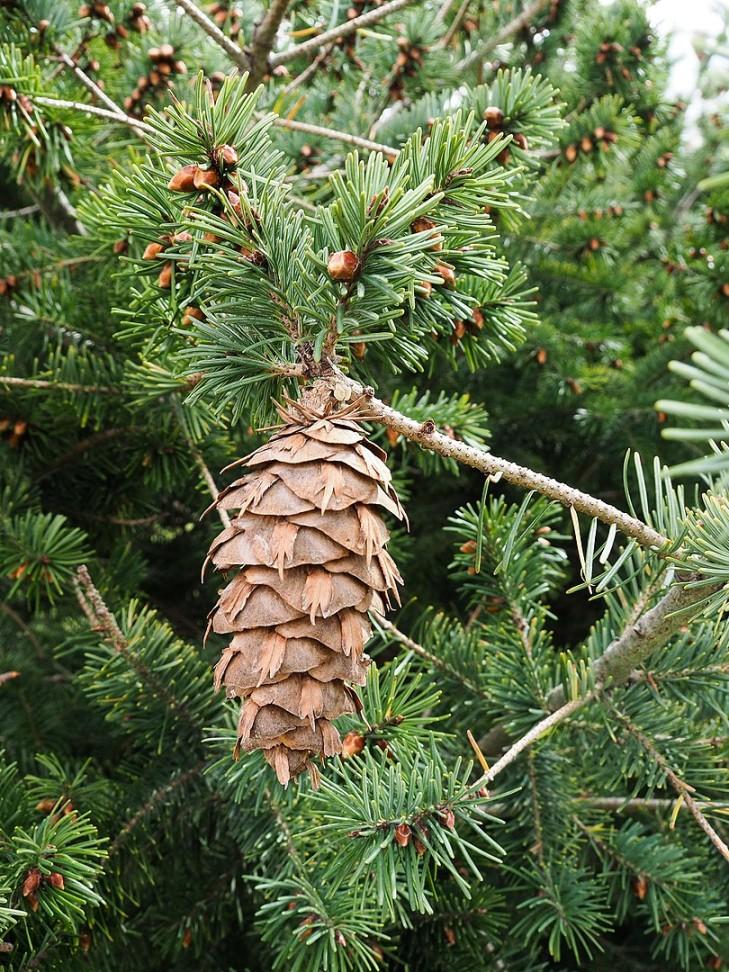
Douglas fir is a towering evergreen that shapes forests across western North America. Despite its familiar name, it belongs to Pseudotsuga, not the true fir genus Abies. Its soft needles and hanging cones with three-pointed bracts are distinctive, but the tree offers much more than recognizable evergreen foliage: its new growth and resin have long been valued as food, herbal materials, tools and fragrance ingredients.
Spring tips: aromatic and nutritive
New tips emerge bright green in spring, with a fresh, citruslike aroma. They contain vitamin C (ascorbic acid) and have traditionally been used in teas and other spring preparations. Northwest ethnobotanical accounts describe Douglas-fir needle and twig teas as tonics.[1]
The foliage also contains volatile monoterpenes, including terpinolene, sabinene and pinene, which contribute to its recognizable conifer scent. These aromatic compounds are important to the character of Douglas-fir essential oil and other fragrant preparations.[2]
Resin: protection, medicine and practical craft
When Douglas fir is injured, its sticky oleoresin helps seal the exposed surface. Its mixture of fragrant terpenes and heavier diterpene resin acids provides a water-resistant barrier and contributes to the tree's defenses against insects and pathogens.[3]
Laboratory research on Douglas-fir wood extracts has also documented antibacterial and antifungal activity, adding to scientific interest in the tree's chemical defenses.[4]
Resin has a long practical and herbal history. Haisla people used Douglas-fir pitch for tool bindings, while Blackfoot traditions include using it as glue and for waterproofing moccasins. Ethnobotanical accounts also document pitch used in traditional preparations for cuts and other skin injuries.[5]
These uses belong to a much wider history of working with tree resins across cultures—as adhesives and waterproofing materials, in herbal preparations, and for their aromatic qualities in incense and perfume.[6]
A resin for perfumery
The heavier, slower-evaporating portion of Douglas-fir resin gives it a warm, persistent character distinct from the lively scent of the tips. Resinous materials have long been used to create base notes and natural fixative effects in perfume, contributing balsamic depth and a lingering aromatic foundation.
That contrast between fresh foliage and deeper resin makes Douglas fir particularly interesting as a source of aromatic materials.
At Deschampsia
We gather spring tips for botanical infusions in Glow Serum and Harmony Serum, and distill the foliage for Douglas Fir Hydrosol.
We also work with Douglas-fir resin in Rescue Balm, Gentle Giants Tree Resin Balm and Douglas Fir Aromatic Resin Perfume Oil.
The fresh tips and aromatic resin bring contrasting botanical qualities to our infusions, distillations and perfumes.
Related Field Notes
Pacific Northwest Plants for Skin: A Wildcrafted Field Guide follows the brief spring tip harvest and contrasts it with Douglas fir resin.
Sources
[1] University of Washington Elisabeth C. Miller Library — Douglas fir tea.
[2] Pseudotsuga menziesii: Volatile Profiles ... of Its Essential Oil (2021).
[3] Keeling & Bohlmann, Diterpene resin acids in conifers (2006).
[5] Utah State University Extension — Native American Uses of Utah Forest Trees: Douglas-fir; Washington Native Plant Society — Douglas-fir ethnobotany.