
Plants & ecology · Ingredients & materials · Skin & hair
Rosehip
Rose hips and rosehip oil · Rosa species · Rose family (Rosaceae)
Rose hips are the colorful fruits that develop after roses flower. They are valued in herbal preparations and as sources of fruit powders and skin-conditioning oils.
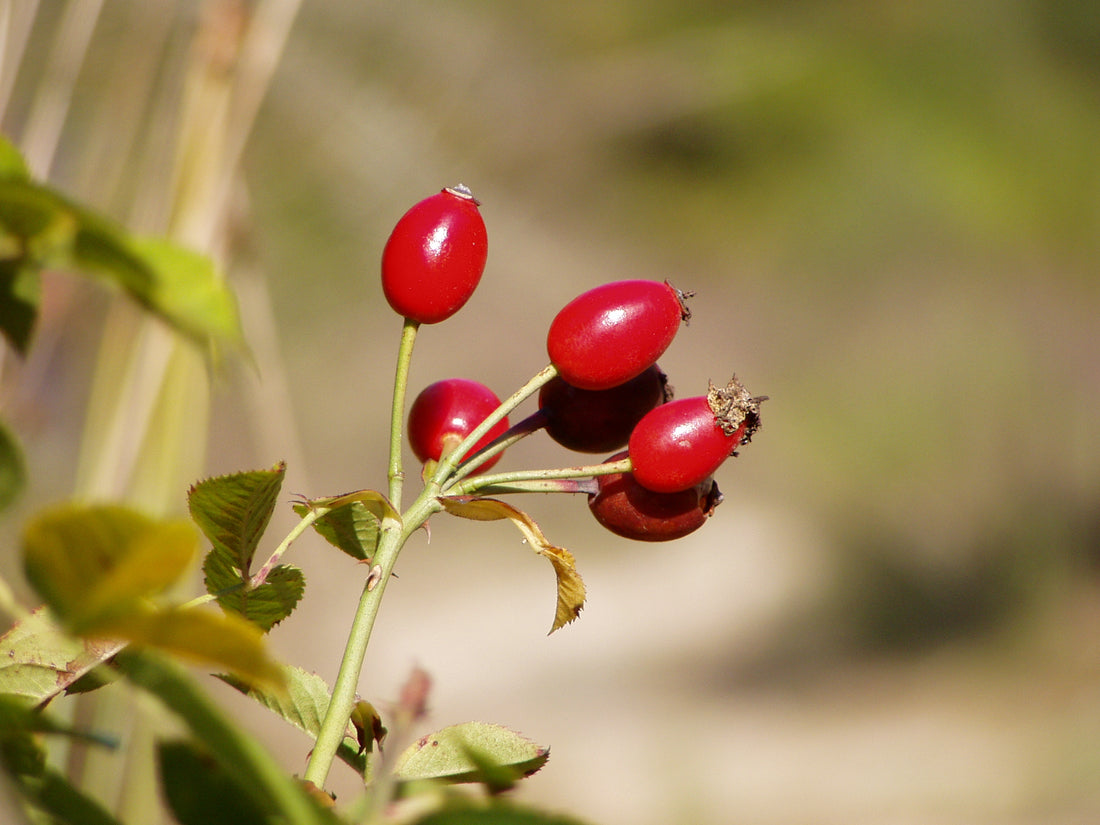
After roses finish flowering, many develop rounded or oval rose hips that ripen from green to orange, red, or occasionally darker colors. They are a familiar sight in hedgerows and wild rose thickets in autumn, where the persistent fruits provide food for birds and other wildlife. Rose hips also have a long history in food, herbal preparations, and botanical skincare.
The fruit behind the flower
A rosehip is a fruit—more precisely, an accessory fruit. Its fleshy outer portion develops from the flower's hypanthium, a cup-shaped structure that encloses numerous small, hard achenes, each containing a seed. Both the outer portion and the seeds are useful botanical materials, but they contribute different compounds to a preparation.[1]
Many rose species produce hips. Dog rose (Rosa canina) is widely associated with traditional rosehip teas, syrups, and powders. Sweet briar (Rosa rubiginosa), also known as eglantine and often marketed as rosa mosqueta, is another important source of rosehip seed oil. The two are distinct species within the same genus.[2,5]
Rose hips in herbal traditions
Rose hips have traditionally been prepared as teas, syrups, jams, and preserves. The fruit's fleshy portion is notable for vitamin C and contains carotenoids, flavonoids, and other phenolic compounds. Pigments including beta-carotene and lycopene help give many ripe hips their orange-red color.[2]
These constituents make the fruit interesting beyond its familiar tart flavor. In powdered rose hips, the fruit material is retained rather than pressed for oil.
Why rosehip seed oil is valued in skincare
Rosehip seed oil is obtained from the oil-bearing seeds enclosed within the hips, commonly by pressing. Oils from species including Rosa rubiginosa are particularly rich in linoleic acid (omega-6) and alpha-linolenic acid (omega-3), alongside oleic acid. Smaller amounts of oil-soluble compounds include tocopherols (vitamin E compounds) and phytosterols.[3,7] Unlike the fleshy rose hip, pressed seed oil is valued primarily for its lipids, not vitamin C.[4]
This fatty-acid profile helps explain rosehip oil's place in skincare. As an emollient, it softens rough-feeling skin and leaves a thin conditioning layer that helps limit moisture loss. Linoleic acid also has a role in the skin's own barrier: it is part of specialized ceramides, the lipids that help maintain the outer skin layer.[8]
Rosehip seed oil is often called a dry oil. In skincare, this describes its relatively lightweight, quick-absorbing feel and the softer, less greasy finish it tends to leave compared with richer oils. It does not mean the oil dries out the skin.[11]
Studies have examined these benefits directly. In a 2016 university study, pure Rosa rubiginosa seed oil improved measured skin hydration, with researchers also evaluating changes in skin firmness and wrinkle appearance.[9] A small 2025 pilot involving Rosa canina seed oil reported improvements in some measures of facial texture after five weeks.[10]
At Deschampsia
We use organic sweet briar (Rosa rubiginosa) seed oil in Glow Serum, Harmony Serum, and Eye Serum as a lightweight, conditioning component of these water-free facial oils.
In Glowing Turmeric & Rosehip Face Mask, we use wildcrafted dog rose (Rosa canina) fruit powder blended with colloidal oats, turmeric, carrot, and marshmallow root.
Related Library entries: Rose, Extraction & Solubility, Hydration & Moisturizing, and Sea Buckthorn.
Photograph: Júlio Reis (Tintazul) · CC BY-SA 2.5.

Explore the products
Sérum Floral Éclatant →Sérum Botanique Harmonisant →Sérum contour des yeux | Roll-on botanique →Masque visage Éclat Curcuma & Cynorhodon →Sources
[1] University of Michigan, Rosa canina — Fruit and Seed Description. Rosehip structure: hypanthium and enclosed achenes.
[2] Recent advances and insights into the bioactive properties and applications of Rosa canina L. and its by-products (2024). Fruit constituents, traditional preparations, carotenoids, vitamin C, and processing.
[3] Safety Assessment of Rosa canina-derived Ingredients as Used in Cosmetics (2022). Rosehip cosmetic oil chemistry and ingredient terminology.
[4] Liposomal Bilayer as a Carrier of Rosa canina L. Seed Oil: Physicochemical Characterization, Stability, and Biological Potential (2023). Rosehip seed-oil lipids and oxidative stability.
[5] Royal Botanic Gardens, Kew, Rosa rubiginosa — Plants of the World Online. Botanical identification of sweet briar.
[6] European cosmetic ingredient inventory — Rosa Rubiginosa Seed Oil. INCI terminology for oil expressed from Rosa rubiginosa seeds.
[7] Oshadhi / AYUS GmbH, Rosa rubiginosa Seed Oil — Safety Data Sheet. Ingredient-specific fatty-acid ranges; an illustrative supplier specification rather than analysis of Deschampsia's own batch.
[8] The Role of Linoleic Acid in Skin and Hair Health: A Review (2025). Linoleic acid in epidermal ceramides and skin-barrier lipids.
[9] Van der Walt (2016), Transdermal diffusion, stability and clinical efficacy of cosmetic formulations containing Rosa rubiginosa rosehip seed oil. University research examining pure seed oil, skin hydration, elasticity and appearance.
[10] Oargă et al. (2025), The Effectiveness of a Topical Rosehip Oil Treatment on Facial Skin Characteristics. Small, non-blinded five-week pilot using Rosa canina seed oil.
[11] Healthline, What Is Dry Oil? (2020). Common cosmetic use of “dry oil” for a lightweight, less greasy skin feel.