
Plants & ecology · Ingredients & materials · Skin & hair
Horsetail
Equisetum species · Horsetail family (Equisetaceae)
An ancient, spore-bearing plant with jointed stems rich in silica, a history of practical uses, and a place in traditional hair and skin preparations.
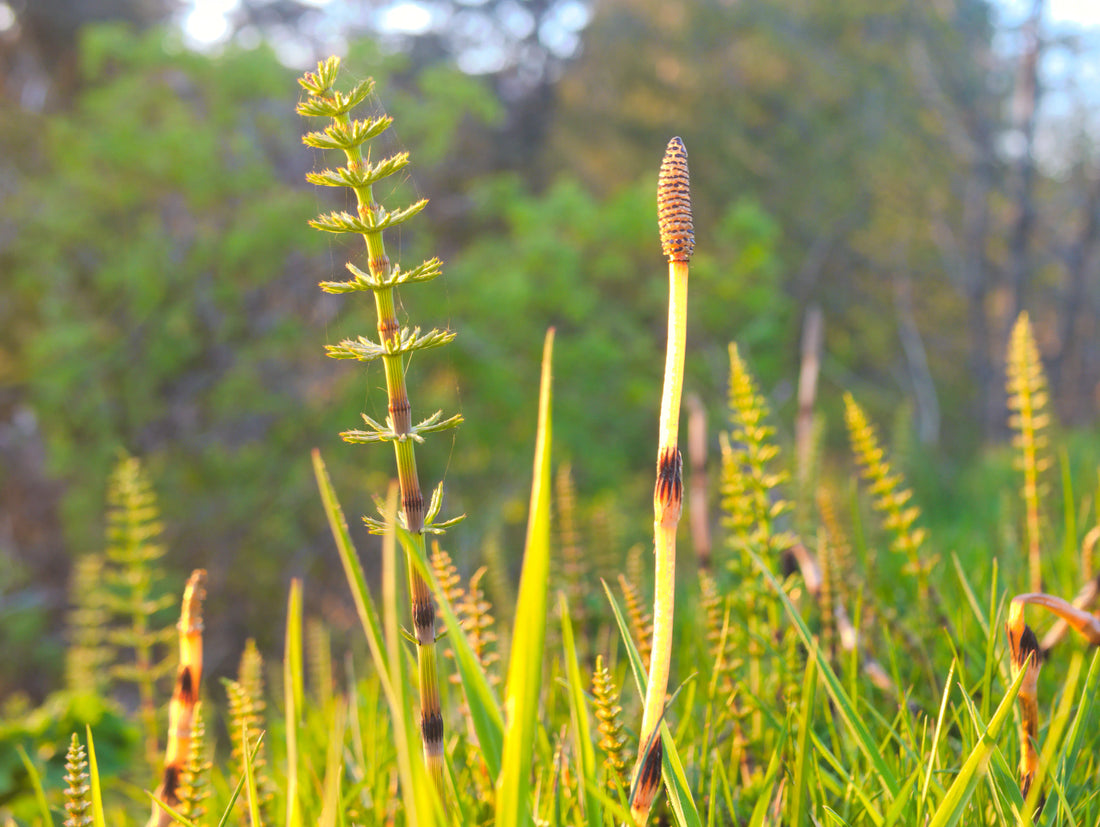
Horsetails are remarkable survivors of an ancient lineage of vascular plants. They have no flowers, fruits or seeds, reproducing instead by spores. Their jointed, hollow stems and regularly spaced branches give many species an almost architectural appearance.
Modern horsetails belong to the genus Equisetum, a small remnant of a much more diverse group of plants whose relatives flourished long before the evolution of flowering plants.
An ancient plant with unusual stems
Field horsetail, Equisetum arvense, is familiar in moist meadows, stream margins, disturbed ground and other places where its extensive underground rhizomes can spread.
It produces two strikingly different types of shoots. In early spring, pale, unbranched fertile stems appear, each topped by a cone-like structure that releases spores. These are followed by green vegetative stems with whorls of slender branches, giving the plant its familiar bottlebrush appearance.[1]
Unlike flowering plants, horsetails reproduce through a life cycle involving spores and a separate, small gametophyte generation. Their form provides a living reminder of the evolution of land plants.
Silica and the plant's structure
One of horsetail's most distinctive characteristics is its ability to accumulate silica, a form of silicon dioxide, within its tissues. Silica contributes to the rough, abrasive feel of its stems.
This feature gave certain horsetail species, particularly scouring rushes, a practical role as materials for polishing wood, metal and household utensils.
Field horsetail also contains flavonoids, including derivatives of quercetin and kaempferol, as well as phenolic acids. Research on extracts of E. arvense has examined these compounds for antioxidant activity.[1, 2]
Horsetail's mineral-rich structure and its diverse plant compounds are separate aspects of its chemistry, both relevant to understanding its traditional reputation.
Herbal traditions
In European herbalism, field horsetail has been described as diuretic, traditionally used to increase urine production, and astringent, associated with tightening or toning preparations.
The herb has been prepared as teas and decoctions, as well as external washes, baths and compresses. Traditional herbal references also describe horsetail as vulnerary, reflecting its historical place in preparations for minor skin injuries.[3]
Horsetail has a long association with hair and nails, largely connected to the plant's reputation as a source of silica. These traditional associations have contributed to its popularity in botanical hair-care preparations.
Different horsetails
The name horsetail describes a group of related species rather than one interchangeable herb. Field horsetail, E. arvense, is widely discussed in European herbal literature. Other species, such as E. hyemale, are particularly associated with the coarse stems used for scouring.
Species identification is important because horsetails differ in their growth forms and chemical profiles.
At Deschampsia
We use horsetail alongside nettle in botanical preparations for hair and scalp care.
It appears in Hair & Scalp Elixir, an oil-based botanical preparation, and in Active Botanical Hair Wash Bar, which incorporates a horsetail and nettle infusion.
These formulations bring horsetail into contemporary hair care while retaining its connection to the longer history of prepared herbs.
Explore the products
Elixir para Cabello y Cuero Cabelludo – Fortalece • Nutre • Revitaliza →Barra de champú botánico activo →Sources
[1] Washington State University Extension — Horsetails. Morphology, reproduction, silica and rhizomes.
[2] Phenolic Compounds in Field Horsetail (Equisetum arvense L.) as Natural Antioxidants (2008). Phenolic constituents and experimental antioxidant activity.
[3] European Medicines Agency — Horsetail Herb. Traditional herbal uses and assessment of evidence.